A brand story enhances marketing by giving every channel the same reason to exist. Ads, your website, sales calls, emails and posts stop competing with each other and start adding up, because they all draw on one account of who you are, who you help and why it matters. People remember a consistent story far more readily than a list of features.
This post goes through where that actually shows up: advertising, your site, sales, email, social, PR and hiring. I'll also cover how to tell whether it's working, what to do on a small budget, and the habits that quietly stop a brand story doing its job. If you want the basics first, start with what brand storytelling is.
Why does a brand story improve marketing at all?
Most marketing is produced by several people at different times, for different channels, often under pressure. Without a shared story, each piece answers the question "what should we say?" from scratch. The ad agency says one thing, the person running Instagram says another, and the sales team has their own pitch that's been evolving for years. A customer meeting all three sees three slightly different companies.
A brand story fixes that by sitting underneath everything. It's the answer to "what do we say?" that was decided once, properly, so it doesn't get reinvented every Monday morning. That makes your marketing recognisable. Recognisable marketing gets remembered, and remembered marketing is cheaper to run, because you aren't re-introducing yourself every time.
There's a trust side to it as well. Censuswide surveyed 2,004 UK adults in October 2023 and found that 42% agreed brands who make their mission and values visible are more trustworthy, and 40% said they'd be likely to buy after seeing a piece of content showing a brand's values lined up with their own. Only 35% thought brands were doing a good job of making those values visible. That gap is where a clear story earns its keep.
What does a brand story do for advertising?
It gives the ads a point of view, which is the thing most ads are missing. A product-led ad can say what you sell. A story-led ad says why you sell it, and that's the part a person can repeat to a friend.
Patagonia's "Don't Buy This Jacket" advert, run as a full page in the New York Times on Black Friday 2011, is the one everyone cites, and it's worth citing because it only works if the company means it. The ad asked people to think before buying, and it landed because the rest of the brand, the repair service and the environmental positioning, already said the same thing. The ad was one piece of a story that existed before it. A clever line without that foundation reads as a stunt.
On a smaller budget the lesson holds. If you're running paid ads, the story tells you which proof points to lead with and which to drop. You stop testing twenty random angles and test three that all belong to the same brand.
How does it help your website and sales conversations?
Your website is usually where the story gets tested first, because it's where a stranger decides in a few seconds if you're worth another minute. A homepage built on features and service lists looks like every other homepage in your sector. One built on a clear story, who you started for, what you believe about the work, what it looks like when it goes well, gives the visitor something to react to.
Sales is the same. Anyone who's sat through enough pitches knows the ones that stick are the ones where the person tells you something true about why they do the job. A brand story gives your whole team that material. It means the person who joined last month can explain the business as well as the founder, because the story's written down and they've watched it on film.
This is where video earns its place. A brand story video does the explaining in the founder's own voice, and a sales team can send it ahead of a meeting so the first conversation starts further along. If you want to see how that works with real people, our film for La Fromagerie carries the account of a business through four voices rather than one.
Four in ten are open to buying once they've seen what a brand stands for, but only about a third think brands show it well. That gap is the opportunity.
Source: Censuswide, Brand Values Narrative Report 2023/24 (2,004 UK adults, fieldwork 13 to 16 October 2023)
What about email, social and PR?
Email is where a brand story quietly pays off, because email is a relationship channel. Subject lines and offers get opens. The sense of who's writing keeps people from unsubscribing. If your emails sound like the same person who made the film and wrote the About page, they build on each other.
Social is hungry. It needs something to say several times a week, and a brand story is a supply of material. Each part of the story, the origin, the way you work, a customer's before and after, a thing you believe that others in your sector don't, can become a dozen posts. Our guide to turning one brand film into a year of content goes into how.
PR works the same way. Journalists and podcast hosts don't want a press release about your product. They want a reason to talk to you, and a story with a real person and a real stake in it is exactly that. It's far easier to pitch "here's why this plumber started filming every job" than "here's a plumbing company".
Can a brand story help with hiring and partners too?
Yes, and it's one of the most overlooked effects. The people deciding whether to apply to you, or whether to put you forward to their own clients, are using the same cues customers do. A clear story tells a candidate what the place is like before they've set foot in it, which means the people who apply already half agree with you.
For partnerships and referrals the effect's even stronger. If a supplier or an existing client can describe what you do and why in two sentences, they'll recommend you more often, and to the right people. If they can't, they'll say "they're good, I think, they do something with websites?" Your brand story is what they'll quote.
What does it look like in practice when it's working?
You'll notice a few things, usually in this order:
- The marketing gets easier to produce, because you know what's on-brand without a meeting about it.
- Different channels start to feel like the same business. People who've seen an ad and a post say "oh, it's you" when they land on your site.
- Sales calls begin further in. The prospect has watched the film or read the story and already has a view.
- You say no to more ideas. That sounds like a loss, but it's the sign a story is doing its work, because ideas that don't fit stop getting through.
I'd be careful about promising a measurable lift in any single number. Brand effects are slow and tangled up with everything else you're doing, and anyone who tells you a story will deliver a guaranteed percentage is guessing. What you can track honestly is direction: more enquiries that mention the film, shorter sales cycles, better-fit leads, people quoting your language back to you.
How do you start if the budget is small?
Start by writing the story down in plain words before spending anything on production. A page covering who you help, what you saw that made you start, what you do differently and what a good result looks like. Our piece on what a brand story should include lays out the parts. Then check every channel you already run against it. You'll find posts that don't fit, an About page that says something else, and a pitch deck that's out of date.
After that, pick one place to tell it properly. For most businesses I'd pick a single film, because it does the human part that text can't, and it can be cut into pieces for everything else. That's the logic behind a documentary approach: you film the real people, ask real questions, and the story comes from what they say rather than from a script. It also connects to something I wrote about in why a brand film needs a business goal. A story with no job to do just drifts.
You don't have to start with the expensive version. A tidy, honest story told on the website and in sales conversations beats a polished film built on nothing.
What stops a brand story enhancing your marketing?
Four things come up again and again:
- **It's invented in a workshop and never believed.** If the team can't say it in their own words, it won't survive contact with a customer.
- **It lives in one place.** A story that's on the About page and nowhere else is a paragraph, not a brand story.
- **It's all about the company.** The best ones keep the customer at the centre and show your business as the thing that helped them.
- **It changes every year.** A consistent story needs repetition. By the time you're bored of it, people are only just starting to notice.
The other one is quieter: treating the story as the marketing instead of the foundation for it. A story doesn't replace the offer, the pricing or a decent follow-up. It makes all of those easier to understand and easier to trust.
A brand story decides what your marketing is allowed to say, and that's most of the battle.
Which brands do this well?
The usual examples are big names, and they're useful because the effect's easy to see. For a wider look at who's using story deliberately, see which brands use storytelling, and for a worked case there's a brand story example broken down line by line.
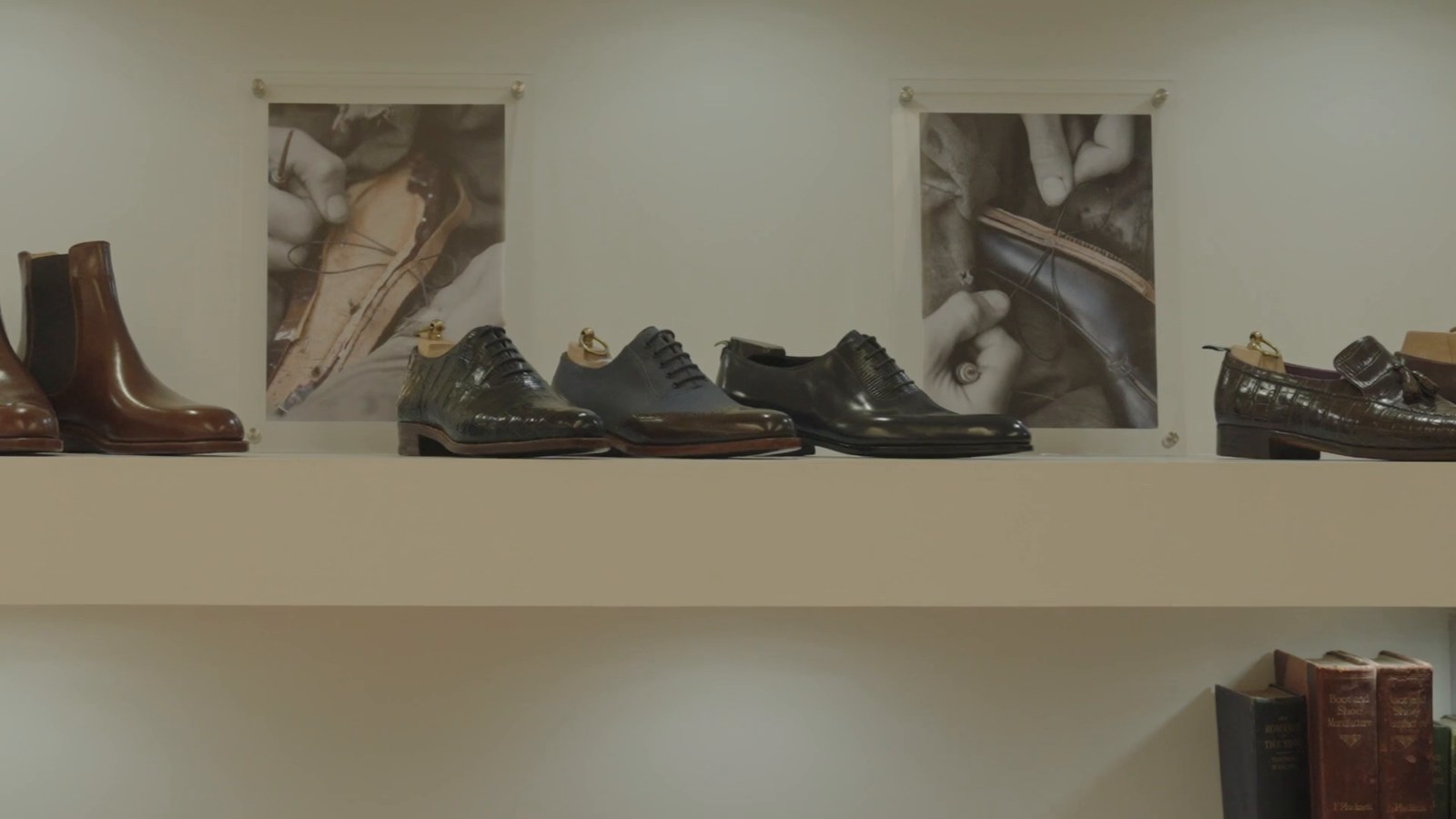
What I'd add from the other side of the camera is that the businesses who get the most out of it are rarely the famous ones. They're the shoemaker, the jeweller, the cheesemonger and the drainage firm who know exactly why they do the work and have been asked to say so on camera. The story was always there. Our work with Carréducker is a good example, two makers who'd already documented every one of the 210 steps in a pair of shoes. They didn't need a story invented for them. They needed someone to film it properly.
Where does this fit with the rest of your strategy?
A brand story is one part of a larger job, and the full picture is in our complete guide to brand storytelling. If you're weighing up where to put effort first, how to use storytelling in marketing is the practical follow-on to this one.
If you'd like to talk about telling yours on film, get in touch. If we don't think a film's the right next step for you, I'll say so.