Brands that use storytelling include Dove, Patagonia, Innocent, John Lewis and Hovis among the household names, and thousands of small UK businesses such as craft makers, family firms and independent shops. What they share isn't size or budget. Each has a clear reason for existing and tells it through real people, places or moments rather than a list of features.
This post looks at who does it well, what they actually do, and what a smaller business can take from them. I'm not covering Nike, which has its own post in what Nike's brand story is, or a full walkthrough of one example, which is in a brand story example. Think of this as a tour of the field.
Which big brands are known for storytelling?
A few have become reference points, and it's worth knowing what each one really did.
Dove. The Campaign for Real Beauty launched in 2004 and put ordinary women, not models, at the front of its advertising. In 2013 the brand followed it with Real Beauty Sketches, a film in which a forensic artist drew women from their own descriptions and then from a stranger's. The story was about how people see themselves, and the product barely appeared in it.
Patagonia. The outdoor clothing company ran a Black Friday advert in the New York Times in November 2011 under the headline "Don't Buy This Jacket", asking customers to consider the environmental cost of what they bought. In 2022 its founder, Yvon Chouinard, moved ownership of the company into a trust and a non-profit so that profits go toward tackling climate change. The story and the actions point in the same direction, which is why it holds.
John Lewis. The retailer's annual Christmas advert has become something people look forward to and talk about in the UK. Each one is a short narrative, often with a small emotional turn, and the products are almost incidental. The feeling ends up attached to the shop.
Innocent. The smoothie company began in 1999 when three friends sold their drinks at a London music festival and put out two bins, one marked yes and one marked no, under a sign asking whether they should give up their jobs to make smoothies. The yes bin filled up. That story has been told in the brand's voice ever since.
Hovis. The 2008 "Boy on the Bike" advert, directed by Ridley Scott, followed a boy pushing a delivery bike up a hill through a century of British history. It sold nostalgia and heritage rather than bread, and it's still one of the best known UK adverts.
All five are very different, and none of them is about the product's features. They're about a feeling, a belief or a place, and the product is how you join in.
Do small UK businesses use storytelling too?
Constantly, though many don't call it that. Anyone who explains how they started, shows how the work is done or lets customers speak is telling a story.
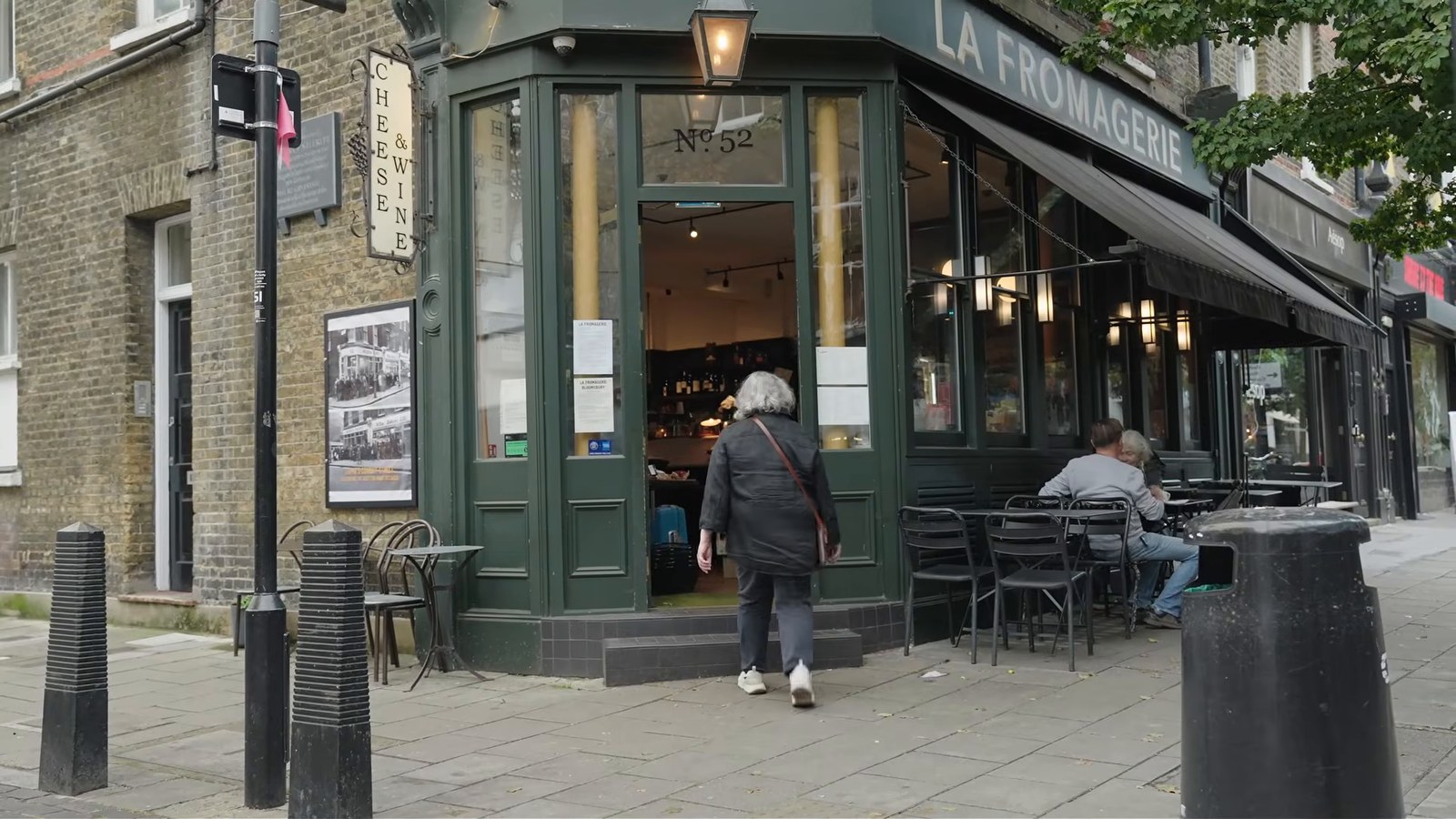
The ones I've filmed are a good cross-section. La Fromagerie tells thirty three years of a cheese business, starting from a garden shed. Carreducker makes bespoke shoes by hand in the Oxo Tower, and the film is about the six months and 210 steps behind each pair. Catherine Marche is a goldsmith who works only in recycled metal, and her film is built around the way she works rather than the pieces in the case. And a hand painted signwriting trade is shown in the workshop and out on the shopfronts.
None of those businesses has a huge advertising budget. They have a way of working that other people find interesting, and a film that lets them show it. That's all storytelling needs as a starting point.
What kinds of business use storytelling most?
Any business where trust, craft or character matters. Looking across the films and brands I know, some sectors turn up more than others.
- Craft and heritage businesses. Makers, food producers and traditional trades, where the process is the product. There's more in filming craft and heritage businesses.
- Charities. Where people give because they believe in the cause. See brand films for charities.
- Professional services. Lawyers, accountants, architects, where the client is buying a person as much as a service.
- Trades and installers. Businesses people have to let into their homes, where seeing the team on camera takes away the fear of the unknown.
- Founder-led businesses of every kind. Anywhere the owner is still part of the picture.
Businesses that sell on price alone use it least, and they tend to struggle when the next cheaper supplier arrives.
Stories nudge what people believe and do, consistently but modestly, which is why brands use them as one tool among several.
Source: Braddock and Dillard, Communication Monographs (2016), meta-analysis of narrative persuasion
Which formats do these brands tell their stories in?
Rarely just one. The big names run films, adverts, packaging copy, social posts and the way their staff answer the phone, all from the same story. Smaller brands do the same on a smaller scale.
- Film. The most direct way to put a real person in front of an audience. Documentary-style films suit makers and service businesses best.
- Written pages. The About page, the product description, the email newsletter.
- Social. Short clips and photographs, each carrying one piece of the story. See storytelling in social media marketing.
- Packaging and physical things. Innocent's labels talk in the founders' voice, and a tradesman's van can tell you plenty before they get out.
- Events and conversations. What people say at the trade stand or on the doorstep.
Can a business with a serious message still use storytelling?
Yes, and often it's where storytelling is most useful. A serious or technical subject is easier to follow when a person explains it. Our work for char.gy is a good case: an interview-led film explaining its B Corp certification in plain language, which went on to become the most watched thing on its channel. The subject was a certification, which most people would call dry. A clear human voice made it watchable.
The same applies to charities, healthcare, finance and energy. The more complicated or sensitive the subject, the more a real person helps. It gives people a way in.
What can a small business take from the big names?
Four things, none of which need a big budget.
Pick one idea and keep returning to it. Dove has returned to the same idea about real beauty for twenty years. A small business should be able to say in a sentence what its story is and check every new piece against it.
Back the words with actions. Patagonia's story carries weight because of how the company is run. Your story should be something your customers could verify if they came to see you.
Use real faces. Innocent's early success owed a lot to three real people the audience could picture. Your own team is your most distinctive asset, and nobody else has it.
Be patient. Brand stories build up over years. John Lewis didn't earn its Christmas slot with one advert. Make the first film, then keep adding to it.
Why do these brands bother?
Because stories move people, though less than the hype suggests. A 2016 meta-analysis by Kurt Braddock and James Dillard, published in Communication Monographs, pooled studies of narrative persuasion. It found positive links between exposure to a story and story-consistent beliefs (37 studies, 7,376 people), attitudes (40 studies, 7,132 people), intentions (28 studies, 5,211 people) and behaviours (5 studies, 978 people). The correlations were small, between .17 and .23. That's research on stories in general rather than any one brand's film, so treat it as a reason the big names keep telling them, not a promise of what yours will earn.
The logic is plain enough. When a brand is remembered for who it is, it gets chosen without a fight. People will pay a bit more, wait a bit longer and recommend you without being asked. If all you've done is describe your features, you're one of several options in a comparison table.
For the wider case, why brand storytelling is important goes through the reasons in more depth.
What do brands that tell good stories have in common?
Looking across all of the above, the pattern is surprisingly consistent.
They stand for something specific. Dove for how women see themselves, Patagonia for protecting the planet, Carreducker for slow, handmade work. You could describe each in one sentence.
They show it rather than say it. Patagonia backed its message with its ownership. Carreducker shows the 210 steps. The proof is visible.
They use real people. Actual customers, makers and founders, not stock footage. This is the biggest thing a small business can copy, because it costs nothing extra to be authentic.
They're consistent. The story appears on the website, in the packaging, on social and in the way staff talk. It isn't a one-off campaign.
The brands people remember aren't the loudest. They're the ones whose story stays the same wherever you meet them.
Can any business use storytelling, or does it need a famous name?
Any business can, and small ones often do it better, because the founder and the team are right there to be filmed. A multinational has to build a story from research and committee. A family firm just has to turn a camera on someone who knows what they're talking about.
What you need is a reason, a person and the willingness to be specific. If you can say why the business exists and who does the work, you've got enough to begin. The rest is shaping it, which is what how to tell a brand story goes through step by step.
A word of caution about copying the famous examples. Dove and Patagonia worked because they were true to the brands behind them. A business borrowing a cause it doesn't hold will be spotted straight away. Choose the story that's yours, even if it seems small. The quietest story told honestly beats a loud one that doesn't fit.
It also helps to remember that none of these brands began as famous. Innocent was three friends and a stall. Patagonia began as a small business making climbing equipment. The stories got bigger because the brands kept telling them, the same way, to the same kind of people, long before there was an audience worth the name.
That patience is the part smaller businesses find hardest. A film that goes out this month won't change your quarter. Ten pieces of honest work over two years will change how people talk about you, and you can start with one afternoon.
How do you find the story in your own business?
Start by asking the people who've been there longest what they'd tell a friend about the place. Then ask a few customers why they chose you and why they stayed. The overlap between those answers is usually the story. It's often something the owner takes for granted, which is why an outsider with a camera and a list of questions can find it in an afternoon.
For a longer example of that process, there's a full breakdown in the story behind the La Fromagerie film. The complete guide to brand storytelling collects every part of the subject in one place. If you'd like help finding yours, see our brand films or get in touch.