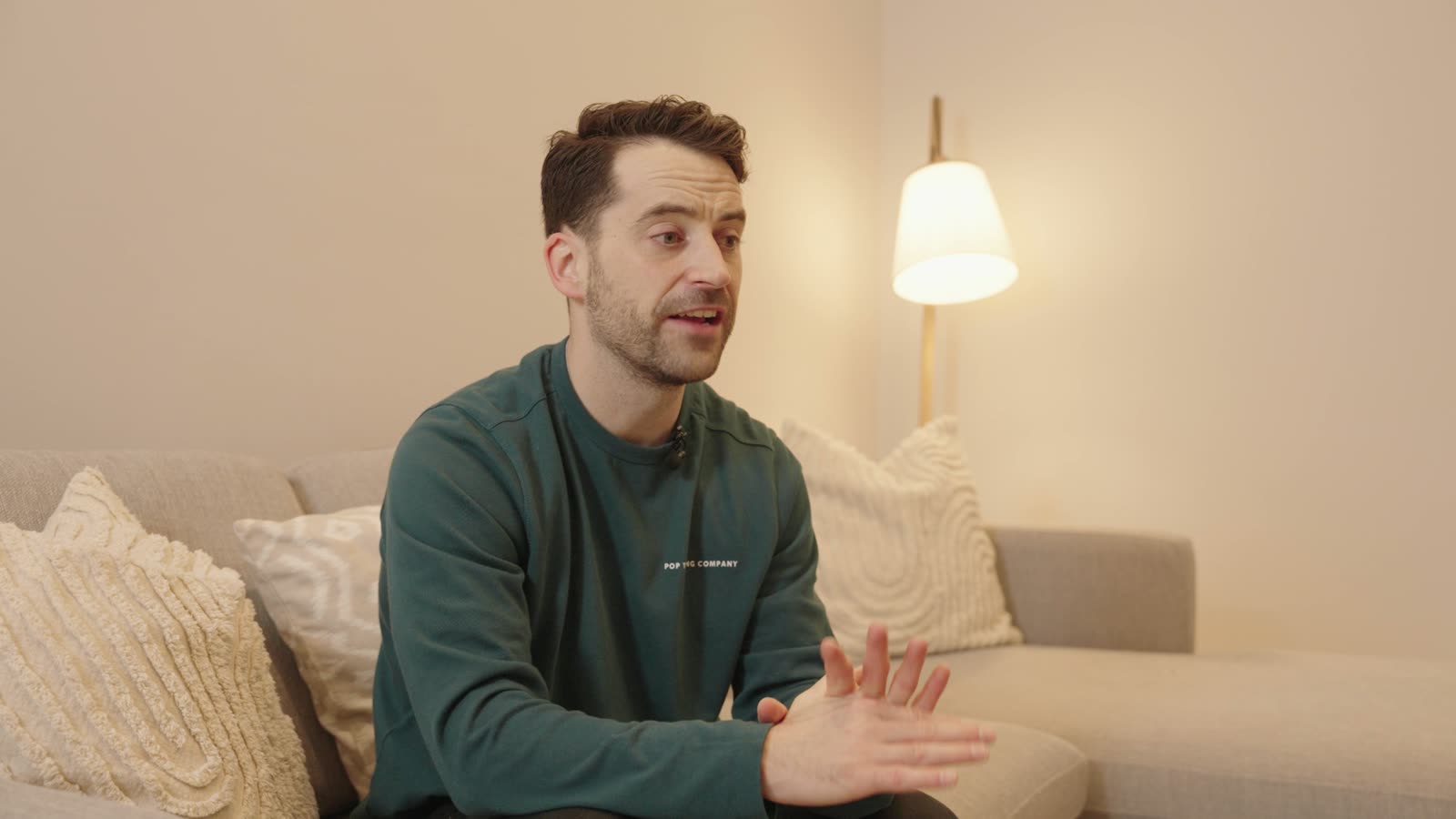
For a filmed interview, wear solid, mid-tone clothes that fit you sitting down, in fabrics that don't rustle, with a collar or a proper waistband so the mic has somewhere to go. Skip fine patterns, other brands' logos and anything that jangles. Bring a second top in a different colour, some blotting paper or powder for shine, and the glasses you always wear.
I've covered the basics in how to prepare for being filmed. This is the longer version, for people who want to know why the rules exist and what to do when their wardrobe doesn't fit them neatly.
What colours look best on camera?
Mid tones. Navy, slate, olive, rust, mustard, a dusty blue or a soft green. They hold their detail, they sit well against most backgrounds, and they don't fight with the face for attention.
The colours that cause trouble are the extremes. Bright white sits at the very top of what a camera can record, so the person exposing the shot has a choice: keep detail in the shirt and let the face go a bit dark, or expose for the face and let the shirt glow. That gets harder the darker your skin is, because the gap between shirt and face is bigger. Solid black has the opposite problem, and it can turn into a flat shape with no folds in it. Neither is banned. They just make the job harder, and an off-white or a charcoal does nearly everything the extremes do without the fuss.
The thing people forget is the background. If you're being filmed against a navy wall and you turn up in navy, you'll disappear into it. You don't need to know the exact set, so just ask the crew what's behind you. A quick message the week before saves a change of shirt on the day.
Why do stripes and checks shimmer on camera?
The effect is called moiré. A camera sensor is a grid of tiny pixels, and a fine, regular pattern is also a grid. When the two grids nearly line up, they interfere with each other and you get rippling bands of colour that crawl across the fabric every time you move. Your eyes see a perfectly nice shirt. The camera sees a television that's lost its signal.
The usual offenders are pinstripes, narrow stripes, small checks, herringbone, houndstooth, fine corduroy and some knitted textures. The problem is that it depends on the camera, the lens and how wide the shot is, so the same shirt can be fine in a close-up and wobble in a wide.
A quick test at home: film yourself on your phone from a few feet away and zoom in slightly. If the pattern starts dancing, it'll probably dance on the day. Moiré is very hard to remove in the edit, so it's one to settle before you leave the house.
Can I wear a logo or branded clothing?
Your own company's branding is usually fine, and sometimes it's exactly right. Check with whoever's making the film, because some brand films deliberately keep logos out so the people feel less like a corporate video.
Other brands' logos are a different matter. A big sportswear logo on your chest pulls focus, and if the film ends up in paid advertising, a visible third-party brand can cause headaches nobody wants.
How should clothes fit when you're sitting down?
Most interviews are filmed seated, and clothes behave differently in a chair. Jackets ride up at the back and bunch at the collar. Shirts pull and gape between the buttons. Trousers rise, and suddenly the wide shot is all shin and sock.
Do the sit test. Put the outfit on, sit in a chair in front of a mirror, lean forward a little the way people do when they're talking, and look. If anything pulls, gapes or bunches, change it.
For the filmed work, the bits of you doing your job, wear what you'd actually wear to do it. If you're up a ladder or at a bench, your normal work clothes look right, and anything else looks like a costume.
 Signwriting Jack
Our film about Signwriting Jack is shot in the workshop and out on the shopfronts. In a film like that the clothes are part of the place, and anything smarter than the work would look odd up a ladder.
What should I wear so the mic is easy to fit?
This is where layers help. The interview mic is usually a small lavalier clipped to the chest, with a cable running down to a transmitter pack on the waistband or belt. I've explained how it all works in lav mics explained, but from a wardrobe point of view, you want three things:
- Somewhere to clip it. A shirt placket, a collar, the edge of a jacket. A plain crew-neck t-shirt works too, though the mic sits a bit more exposed.
- A route for the cable. A buttoned shirt or a jacket lets the cable run inside out of sight.
- Somewhere for the pack. A belt or a firm waistband. A dress with no waistband means the pack goes on a thigh strap or clipped somewhere at the back, which is fine but worth knowing about in advance.
Fabric matters as much as the cut. Cotton and wool are quiet. Silk, stiff new shirts, synthetics and waterproofs rustle against the mic every time you breathe. A chunky knit muffles the voice if the mic has to go underneath it. If you're torn between two outfits, wear the cotton one.
Will my glasses reflect on camera?
They can, but wear them anyway if you normally wear them. You'll look like yourself, and squinting is worse than any reflection.
Reflections come from lights and windows bouncing off the lenses. Moving a light higher or wider usually fixes it, and I've explained where those lights sit in interview lighting explained. Lifting the arms of the glasses very slightly off the ears angles the lenses down, which is an old trick that works more often than it should. An anti-reflective coating helps a lot.
The one pair to leave at home is lenses that darken in daylight. Near a window or outside, they'll slowly turn to sunglasses mid-interview, and the edit can't fix that.
What jewellery should I avoid on camera?
Anything that moves and makes a noise. Bangles and chunky bracelets clink against the table and the chair. Long necklaces swing into the mic. Big hoop earrings can tap a collar mic. Lanyards and ID badges knock against everything, and they often carry a name and a photo you might not want in a film. A watch is fine until you rest your wrist on a hard table, then every gesture becomes a tap.
Your eyes see a perfectly nice shirt. The camera sees a television that's lost its signal.
Rings, studs and a simple necklace that sits close to the neck are usually fine. If a piece matters to you, keep it on and tell the sound person, and they'll work around it.
Do I need make-up for a filmed interview?
Most people don't need much, men included. The main enemy is shine. Interview lighting picks up oil on the forehead, the nose and the top of the head, and a shiny patch reads as sweat even when you're calm.
- For everyone: a translucent powder or blotting papers for shine, lip balm, and moisturiser that's had time to sink in.
- If you don't usually wear make-up: powder is enough. If you shave, do it a few hours before rather than right before, so any redness settles. Bald heads shine more than you'd think, so powder there too.
- If you do usually wear make-up: wear your everyday look, slightly more defined if anything. Go easy on shimmer and highlighter, which turn into hot spots under lights, and match foundation carefully at the jaw so there's no line.
What should I bring as a backup?
A small bag that saves a lot of trouble:
- A second top in a different colour, in case the first clashes with the background or shimmers.
- A plain t-shirt or vest to wear under a shirt, which helps the mic and hides it.
- Blotting papers or powder, lip balm, a comb or brush.
- Your glasses case, and contact lens kit if you use one.
- A lint roller, because dark fabric shows every hair under good light.
If you're organising the shoot for other people, forward them this a week before rather than the night before. And if you want the whole planning side in one place, our free playbook, Before the camera comes out, covers it. When you're ready to talk about a film, tell us about the business.