Most interviews are recorded on a lavalier mic, the small clip-on one, often with a shotgun mic on a boom pole above the speaker as well. The lav sits on the chest a few inches from the mouth, so it hears the voice clearly even in a noisy room. A boom sounds more natural but needs someone holding it, and a handheld mic is for news, events and vox pops, where nobody minds it being in the shot.
If you're paying for a film, sound is the part you'll notice least when it's right and most when it's wrong. People will sit through a slightly soft shot. They'll click away from a voice that crackles, booms or disappears under traffic.
What types of microphone are used for interviews?
Lavalier mics
A lav is a tiny microphone, about the size of a pea or smaller, on a thin cable that runs to a transmitter pack or a recorder on the belt. Being that close to the mouth means the voice is far louder than the room around it. Most lavs are omnidirectional, so they hear in every direction equally, and the speaker can turn their head without the level dropping away.
The catch is that a lav lives on clothing, so it hears clothing. Every brush of a lapel or tap on the chest goes straight into it.
Shotgun mics on a boom
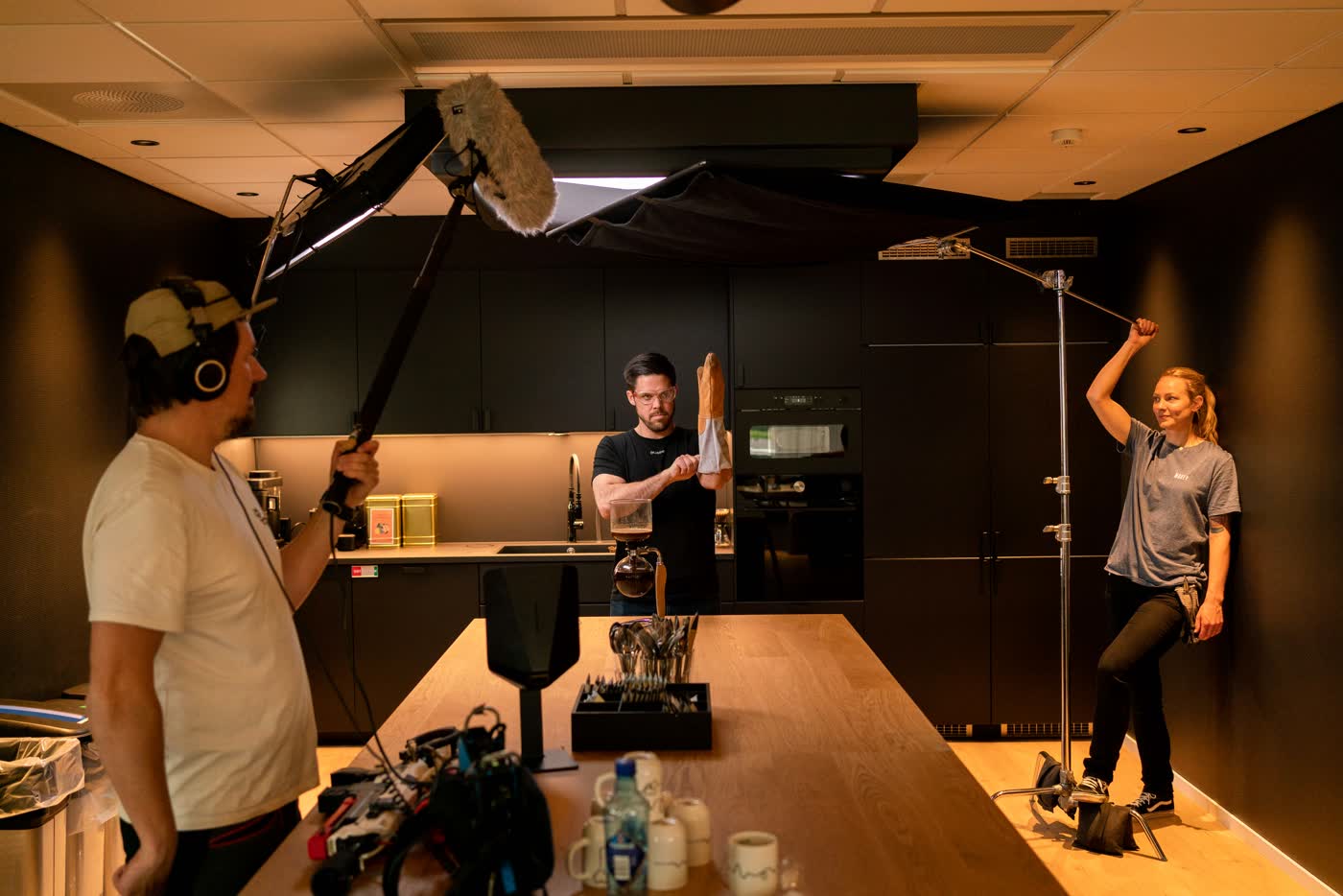
A shotgun is a long, narrow microphone that mostly hears what it's pointed at and turns down sound from the sides. On an interview it's held on a boom pole just above the top of the frame, angled down at the mouth, by a sound recordist who follows the speaker. Because it sits in the air rather than on the body, it sounds open and natural, closer to how you'd hear the person if you were sat across the table from them.
It needs a reasonably quiet room and someone whose whole job is holding it, and in a small room with hard walls it picks up more echo.
Handheld mics
The one you see on the news. It's tough and good at ignoring background noise, and it's in the shot, which is fine for an event or a reporter stopping people in the street. For a documentary it's usually wrong, because it turns a conversation into a press interview and everyone watching can feel it.
Why use a lav and a boom together?
On a properly crewed interview you'll often see both running at once, recorded to separate tracks. The boom gives the more natural sound, and the lav covers the moments when a bus goes past or the speaker leans out of the boom's sweet spot. Two microphones on one voice is cheap insurance on a recording you can't get back.
If you're filming on your own, a lav on its own is usually the better bet. A shotgun sat on top of the camera is too far from the speaker for a sit-down interview and hears the room as much as the voice.
Where should a lav mic go?
The usual spot is the middle of the chest, on the breastbone, roughly a hand's width below the chin. That's close enough for a strong, clear voice and far enough down that breaths and lip noise don't take over. Go higher, onto a collar, and the voice gets thinner and changes every time the person looks down. Go lower, towards the stomach, and the room starts creeping in.
Two things decide the exact spot:
- Which way they'll turn. If the interviewer sits to the speaker's left, put the mic a touch left of centre so the voice stays on it when they turn to answer.
- Jewellery, lanyards and ties. Anything that can swing will tap the mic. Take it off or tape it down.
Visible or hidden is a choice. A small mic clipped neatly to a shirt is completely normal in a documentary, and it usually sounds better than a hidden one. When someone's in their own clothes in their own workshop, I'd rather see a tidy mic than lose half a sentence to rustle.
How do you hide a lav mic under clothing?
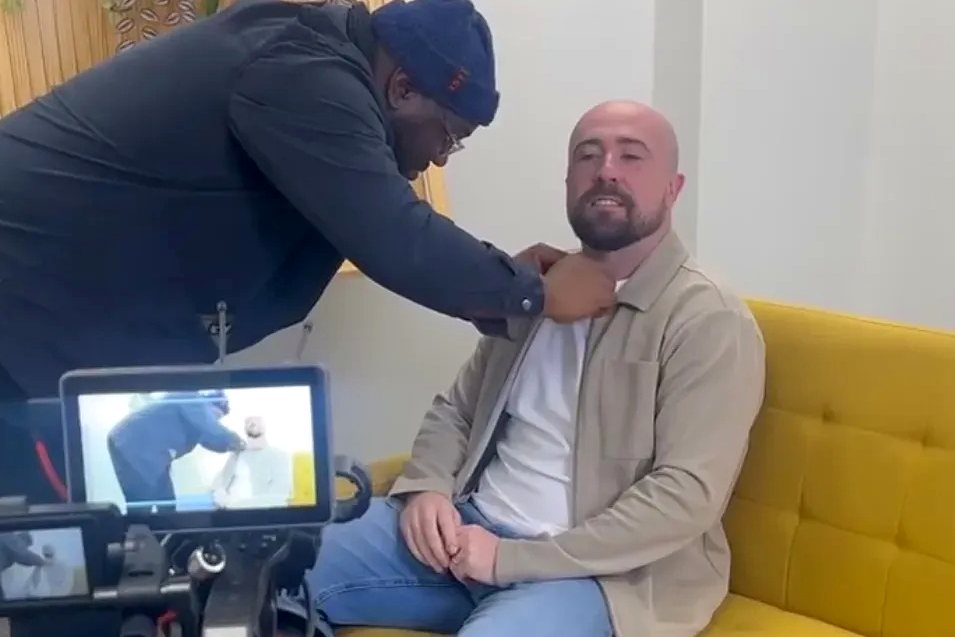
Hiding a lav is a small craft of its own, and the aim is always the same. Stop the mic moving against the fabric, and stop the fabric moving against the mic.
- Tape it down. Sound recordists use double-sided toupee tape, often folded around the mic so there's a layer between the capsule and the cloth, then fixed to the skin or the inside of the shirt.
- Build a small gap. A soft pad or a purpose-made cover between the mic and the shirt stops the two rubbing directly.
- Loop the cable. A small loop taped just below the mic soaks up any tug, so a movement at the belt doesn't drag the capsule across the fabric.
- Keep the front clear. The mic needs to face out through as few layers as possible. Under a thin cotton shirt is fine. Under a heavy jumper the voice goes muffled.
Clothing matters more than people expect. Cotton and wool are quiet. Synthetics, waterproofs, silk and stiff new shirts crackle every time someone breathes. If you're the one being filmed, plain cotton is the easy answer, and there's more on that in how to prepare for being filmed.
Why does my lav mic sound scratchy?
Nearly always it's clothing rustle. It sounds like crackling, scratching or a dull thump, and it lines up with the speaker moving their arms, shifting in the chair or patting their chest to make a point. It's one of the hardest things to clean up afterwards, because the noise sits right on top of the voice.
Before you blame the mic, check these:
- Is the clip or tape loose, so the mic can slide?
- Is the cable rubbing on a seam or a button further down?
- Is a necklace, lanyard or tie touching it?
- Is the person a hand talker? Some people tap their chest on every point. Move the mic slightly off centre, away from that hand.
If the voice crunches when someone laughs, that's a different problem: the level's set too high and the recording is clipping. Noise reduction in the edit can soften rustle, though push it too far and the voice sounds watery. Fixing it on the day is always better, which is the whole argument for a second mic.
People will sit through a slightly soft shot. They'll click away from a voice that crackles.
Around a third of viewers name clear audio as something that keeps them watching, so sound deserves the same budget conversation as the camera.
Source: TechSmith, Video Viewer Study 2024 (nearly 1,000 respondents)
How do you stop wind noise on a lav?
Outside, the enemy is wind. Even a light breeze across an uncovered mic causes a low rumble and loud pops that wreck a sentence. The fix is a windshield: a small foam cover for gentle air, and a furry cover, which the industry calls a dead cat, for anything stronger. The fur slows the air down before it reaches the capsule.
A hidden lav has a head start, because the clothing works as a windshield. It's one of the few times hiding the mic actually helps. Beyond that, the easy wins are turning the speaker's back to the wind, using a wall or a doorway as shelter, and recording thirty seconds of the location on its own, called room tone or a wild track, so the editor has something to smooth the gaps with.
If you've ever seen what looks like a small grey animal on a pole at a film shoot, that's a boom in its windshield.
 Carreducker
Our film for Carreducker is a good example of why interview sound needs planning. Two founders who finish each other's sentences, filmed as one conversation in front of their wall of lasts. Two voices overlapping in a workshop is a sound problem as much as a picture one, because each person has to come through clearly for the edit to hold together.
What does this mean if you're paying for a film?
Ask who's looking after sound on the day. On a small shoot it might be the camera operator doing both, which can work for one interview in a quiet room. For more than one voice, a noisy location or someone moving about, a dedicated sound recordist earns their day rate quickly. It's worth asking who does the sound mix too. On our films the grade and mix are done by people who only do that, and the films page shows how the rest fits together. If the mic is wireless, there's a second set of things that can go wrong, which I've covered in how wireless audio works for interviews.