
Instagram ranks what you post mainly on how long people watch, how many people send it to a friend per person who saw it, and how many like it per person who saw it. Instagram's head, Adam Mosseri, has named those three. This year's real changes are about originality and user controls, not a new secret formula.
Below I've split what Instagram has actually said, with dates, from what marketers guess. I'll cover the signals, the 2026 changes, the myths that won't die (hashtags, posting times), and what a small business should do about all of it, which ends up being a lot more about people on camera than tricks.
 Why One Instagram Post Does Better Than Others, s4digital
What does Instagram say it ranks content on?
Instagram doesn't run one algorithm. Its own explainer, published on 31 May 2023, says Feed, Stories, Explore and Reels are each ranked separately, because people use them differently. In Reels, for example, it looks at which reels you've liked, saved, reshared and commented on, plus how often you've interacted with that creator and information about the reel itself, like the audio and how popular it is. You can read it on the Instagram ranking explained page.
Then in January 2025 Mosseri got specific. As Social Media Today reported on 22 January 2025, he said "the top three signals that matter most for ranking are watch time, likes and sends", and told creators to track average watch time, likes per reach and sends per reach. He added that likes are slightly more important for connected content (your followers) and sends are slightly more important for unconnected content (people who don't follow you yet).
He repeated the point in 2026. Social Media Today covered it on 26 May 2026: "like rates matter more for your followers, and send rates matter more for those who don't follow you." So the answer hasn't moved in two years. That's useful, because it means you can stop chasing each new rumour.
What does "per reach" mean?
It's a rate, so size doesn't decide it. If 1,000 people see a post and 50 of them send it to a friend, that's a send rate of 5%. A small account with a strong rate can beat a big account with a lazy audience, which is the whole reason this matters to small businesses. Mosseri said back in May 2024 that, in his experience, "sends per reach correlate more with overall reach than anything else".
How does watch time work, and do longer videos lose?
This is a common worry, and Instagram has answered it. In February 2025 Mosseri said, as Social Media Today reported, "we don't want to penalize longer videos, which is why we look at not only the percentage of a video that was watched, but also the number of seconds."
So a viewer who gives you 10 seconds of a 60-second video isn't punished for not finishing it. What Instagram hasn't published is how it weights percentage against seconds. Anyone who gives you an exact formula is guessing.
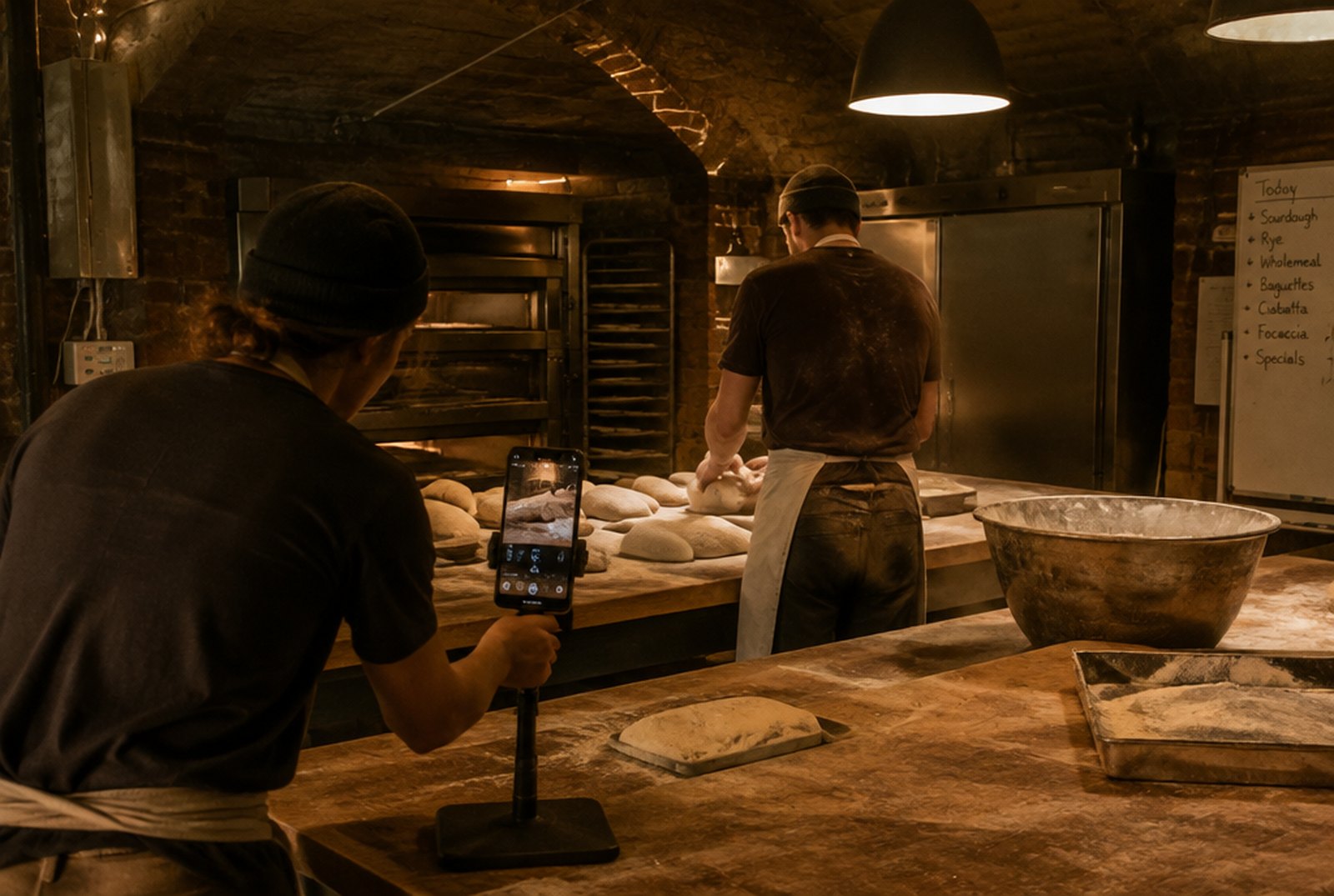
Instagram is deliberately steering recommendations towards original work, so your own footage of your own business is the safest thing you can post.
Source: Instagram Creators blog, Rewarding original creators on Instagram (30 April 2026)
What actually changed in 2026?
Less than the headlines suggest. These are the changes I can tie to a dated Instagram source.
- 15 April 2026: "Your Algorithm", the tool that lets people see which topics shape their recommendations and tell Instagram to show more or less of them, extended from Reels to Explore. It launched on 10 December 2025 and reached Feed globally on 10 June 2026, according to Instagram's own announcement page. For a business, it means your content has to be clearly about something so it lands in the right topic.
- 30 April 2026: Instagram extended its originality rules from Reels to photos and carousels. Accounts that mostly post other people's work no longer appear in the places where Instagram recommends content. This doesn't change what your followers see. The detail is on Instagram's Creators blog.
- 26 May 2026: Mosseri restated the signals (above). No new ones.
- 7 October and 5 November 2026: Instagram's own Edits app got a carousel editor and a desktop version, both listed on the Creators blog. That's tooling, not ranking.
I haven't included a handful of "2026 updates" I found on marketing blogs, such as exact weightings for sends versus likes, because I couldn't trace any of them back to Instagram or a named Mosseri statement. If a number isn't attributed to a person at Instagram on a date, treat it as opinion.
Why does original content matter more now?
Because Instagram says so, and because it's the one 2026 change with teeth. The 30 April update says accounts that publish mostly non-original photos or carousels won't be recommended, and that a restricted account can regain eligibility once a significant share of its recent photos, carousels and reels are classified as original within 30 days. Instagram adds that 75% of recommendations in the USA now come from original posts.
That's a US figure, and I'd rather say so than pretend it's a UK one. But the direction applies to everyone. Reposting a supplier's graphic, a stock image with a quote on it or someone else's clip isn't a growth plan any more. Filming your own team doing the actual job is.
What's real, and what's myth?
Do hashtags still help?
Not for reach. In February 2025 Mosseri said hashtags "don't work" to increase visibility, though they're a way to tell people what a post is about. On 18 December 2025 Instagram went further and began capping captions at five hashtags, saying that "using fewer (up to 5) more targeted hashtags, rather than many generic ones, can improve both your content's performance and people's experience." Both are on Social Media Today's report. So the myth that they're everything is wrong, and so is the myth that they're dead. A few specific ones do a small job. Thirty generic ones do nothing, and you can't use them any more anyway.
Is there a best time to post?
Instagram's 2023 explainer does list the time a post was shared among the signals for Feed, and recency makes sense: people like fresh posts. What I can't find is any Instagram statement that a particular hour wins. Every "best time to post" chart you've seen comes from a vendor's sample of other people's accounts, and your audience isn't theirs. In our own numbers, covered in why one post does better than the others, the hour a post went out told us very little compared with what was in it.
Do you have to engage with similar accounts?
No. In August 2025 Mosseri called this a myth, as Social Media Today reported on 10 August 2025: "feel free to engage with the content that you love, then try to create content that your followers love." He also said the Edits app gave a small reach boost for now, but that it "is not going to be something that's going to be around forever."
Are views the number to watch?
Yes, in the sense that Instagram says so. Since August 2024, "views" has been the main metric across Reels, photos, carousels and Stories. It counts repeat views, so it's a decent measure of attention and a poor measure of how many different people you reached. That's why the rates (sends and likes per reach) tell you more.
What can a small business do with this?
Instagram's signals describe human behaviour: people watching, liking and sending. So the practical work is about making something a person would watch, like and send.
- Open on the point. Watch time starts in the first seconds. Start with the finished job, the reaction or the answer, not a logo.
- Make one thing per post that's worth sending. A price people argue about, a before and after, a mistake you see all the time. Ask yourself who they'd forward it to.
- Test before you commit. Since 13 July 2025, Trial Reels have been open to public accounts with at least 1,000 followers. They show a reel only to non-followers first, with results after about 24 hours, so you can find out what works without putting it in front of your regulars.
- Film it yourself. Originality is the clearest rule Instagram has given us this year. A phone clip of your own work beats a polished graphic you didn't make.
- Be clear what you're about. With Your Algorithm sorting people by topic, a feed that jumps between ten subjects is harder to place.
- Stop obsessing over the schedule. The best time is a time you'll keep to. How often is a question for how to win on social media rather than a setting.
Hashtags, the exact hour and a clever caption are all small levers compared with this.
A send is someone telling a friend your post is worth their time. You can't fake that with a hashtag.
How do you check whether it's working?
Open Insights on a few of your recent posts and ignore likes for a minute. Look at the views, the number of accounts reached, the sends and the average watch time on reels, then divide sends by reach yourself. It takes a couple of minutes with a calculator. After a month you'll have a rough baseline for your own account, and that's the only benchmark that counts, because a plumber in Leeds and a bakery in Bristol aren't being compared with each other.
Then compare your best post with your median one and ask what was different about the content, not the settings. Was there a person? Did it open on the answer? Did it show something finished? That habit will teach you more than any list of algorithm tricks, and it's the same exercise we ran on our own client numbers for why one post does better than the others.
Where do video and real people fit in?
Everywhere, because the three signals reward the thing real people on camera are good at. A person talking to the lens holds attention in a way a static graphic doesn't. A real customer reacting to a finished job is something viewers forward. And nobody can repost your genuine day on site, so you're original by default.
I've filmed brand films and social content for businesses for years, and the posts that travel are rarely the slickest. When we filmed one working day on a drainage job for Super Efficient, the whole day gave us a longform film and a run of vertical clips, and the people on screen did the work of making it watchable. Our piece on real people on camera in an age of AI content goes into why that matters more each year, and social media videos for business covers what to film. If you're thinking about how one shoot feeds weeks of posts, read how to turn one brand film into a year of content.
Instagram will keep changing the interface. Watch time, likes and sends have stayed the same since at least January 2025. If you'd like help making video that earns them, take a look at our films and get in touch.