A shotgun microphone is a long, thin mic that mostly hears what it's pointed at and turns down sound coming from the sides. It's the mic you see on the end of a boom pole on a film set, held just above the frame and aimed at the speaker's mouth. It works best close to the voice, outdoors or in rooms that aren't too echoey, and it struggles when it's sat on top of a camera several metres away.
I've written about lav mics and wireless systems already. This is the other half of interview sound: what a shotgun actually does, where it goes, and why it's so often paired with a lav.
How does a shotgun microphone work?
Inside the long tube is a fairly normal directional capsule. The tube is what makes it a shotgun. It's called an interference tube, and it's covered in slots or holes along its length.
Sound arriving from straight ahead travels down the tube cleanly and reaches the capsule in one go. Sound arriving from the side comes in through the slots at lots of slightly different points, so the pieces arrive at the capsule out of step with each other and partly cancel out. The result is a mic that's noticeably more sensitive in front than at the sides.
Two things follow from that. First, the trick works better at higher frequencies than lower ones, so a shotgun is less directional for low rumble like traffic and air con than it is for voices. Second, sound from off to the side gets quieter and also coloured, sounding thin, hollow and a bit phasey. That colouring matters a lot indoors, which I'll get to.
Length changes things too. A short shotgun is the everyday film and TV mic, easy to boom and forgiving. A long shotgun reaches further and rejects more from the sides, which suits outdoor work and documentaries where you can't get close, but it's heavier, harder to aim and less forgiving when the speaker moves.
What are polar patterns?
A polar pattern is a map of which directions a mic hears best. They're drawn as a shape around the mic, and the ones you'll hear about most are:
- Omnidirectional. Hears equally in every direction. Most lavs are omni, which works because they're so close to the mouth.
- Cardioid. A heart shape. Hears the front well, the sides less, and the back hardly at all. Common on vocal mics.
- Supercardioid and hypercardioid. Tighter at the front than a cardioid, with a small sensitive patch at the back. Good indoors on a boom.
- Lobar. The narrow, stretched shape of a shotgun, very tight at the front with smaller lobes elsewhere, including at the back.
That little patch at the back catches people out. A shotgun pointed down at someone from above is also listening, faintly, to whatever's above it. A shotgun on a camera pointed at a speaker is also listening to the camera operator breathing behind it.
A shotgun hears the sides a bit less. Distance still decides how it sounds.
Does a shotgun mic pick up sound from far away?
Not in the way most people think. It doesn't zoom. It hears a distant voice no louder than any other mic would, it just hears less of the room around it. Distance still wins.
Every time you double the distance between a mic and a mouth, the voice drops by around six decibels, while the room noise stays where it was. So a shotgun at three metres sounds roomier and thinner than the same mic at half a metre, however good it is. On a sit-down interview, the boom wants to be as close as the frame allows, usually somewhere between a forearm and an arm's length from the mouth.
Boom or on-camera: which is better?
For an interview, the boom, by a long way. A boom pole lets the mic sit just out of shot, close to the voice, aimed exactly where it needs to be. The camera can be wherever the picture needs it to be.
The usual position is overhead, angled down at the mouth or upper chest, just above the top of the frame. From there the mic hears the voice, and its less sensitive sides face the walls. Booming from below, pointing up from under the frame, is sometimes used to get away from noise above, like a ceiling full of air con, though it tends to pick up more of the body and the floor.
A good boom operator is doing a real job. They watch the frame edge so the mic never dips in, follow the speaker as they lean and turn, and keep the pole steady for an hour. It's more tiring than it looks.
An on-camera shotgun is fine for what it's for: picking up sound you'll use to line up audio in the edit, recording atmosphere, and grabbing quick moments when you're right next to someone. For a proper interview it's usually too far away, pointed wherever the camera's pointed rather than at the mouth, and it hears the operator's every move. It's better than the camera's built-in mic. It's still the wrong tool for the job.
Should you use a shotgun indoors or outdoors?
Outdoors is where a shotgun is happiest. There are no walls to bounce sound back, so the tight front pattern works exactly as intended. Point it so the noise you don't want, a road or a building site, is off to the side or behind, and angle it down so the background is the ground rather than the street.
Indoors is trickier. In a small room with hard walls, your voice bounces around and arrives at the mic from every direction. The shotgun hears those reflections through its sides and colours them, so the voice can come out hollow and boxy. That's why many sound recordists switch to a hypercardioid mic for interiors. It's shorter, handles reflections more gracefully and is easier to swing in a cramped space. Soft furnishings, rugs and curtains help either way, and picking the least echoey room for the interview is one of the easiest wins there is.
Why do interviews often use a boom and a lav together?
Because they fail in different ways. The boom sounds open and natural, like you're sat across from the person, but it can be caught out by a bus going past or the speaker leaning out of its sweet spot. The lav is right on the chest so it holds up in noise, but it can rustle and sometimes sounds a bit close and boxed in.
Recording both to separate tracks means the editor can pick the better one moment by moment, or blend them. When they're blended, the two need lining up carefully, because the boom is further away and its sound arrives a fraction later, which can make the mix sound thin if it's ignored.
 Southwick D-Day talk
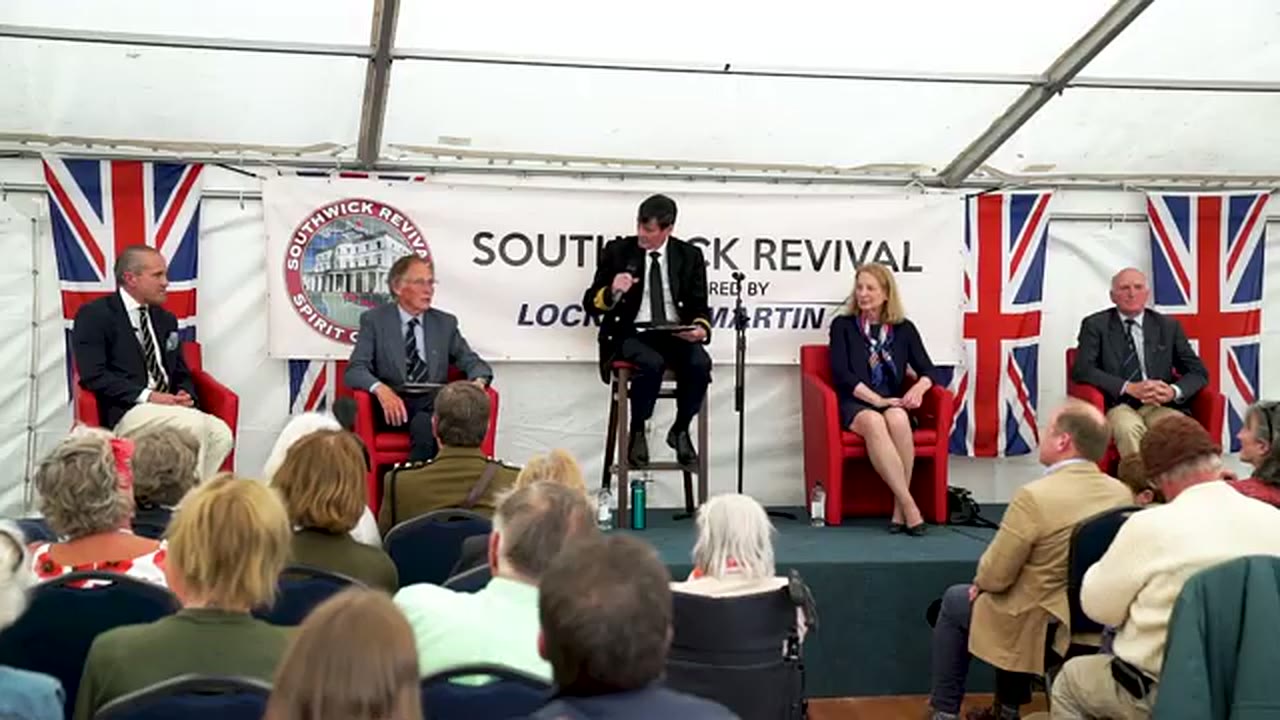
Our coverage of the D-Day eightieth anniversary in Southwick is a good reminder of why sound gets planned in layers. It included a full panel talk recorded end to end in front of a packed marquee, at an event that couldn't be asked for twice. When nothing can be repeated, two sources for every voice is the sensible default.
How do you stop wind noise on a shotgun mic?
With layers of protection, and the more wind there is, the more layers you need.
- Foam. The grey sleeve most shotguns come with. Fine indoors, and for the small rush of air when a boom is swung. Close to useless in a real breeze.
- Slip-on fur. A furry sleeve that fits straight over the mic. Good for on-camera mics and light wind.
- Basket windshield. A cage, sometimes called a blimp or zeppelin, that surrounds the mic with a pocket of still air. Wind hits the cage, not the capsule.
- Fur over the basket. The fluffy grey thing on a pole you see at outdoor shoots. The fur slows the air before it reaches the cage, and together they deal with strong wind.
A low-cut filter, on the mic or the recorder, trims the very low rumble that wind and traffic produce without touching much of the voice. A shock mount, the cradle of elastic the mic sits in, stops knocks on the pole travelling into the recording. Neither replaces proper wind protection, but both help.
The lav needs protecting outdoors as well. I use URSA Fur Circles on lav mics, small furry discs that sit over the capsule under or on the clothing, because a lav catches wind just as easily as a shotgun does. If you want to see how sound fits into everything else on a shoot, what a shoot day looks like walks through it, and our free guide covers the planning before it.