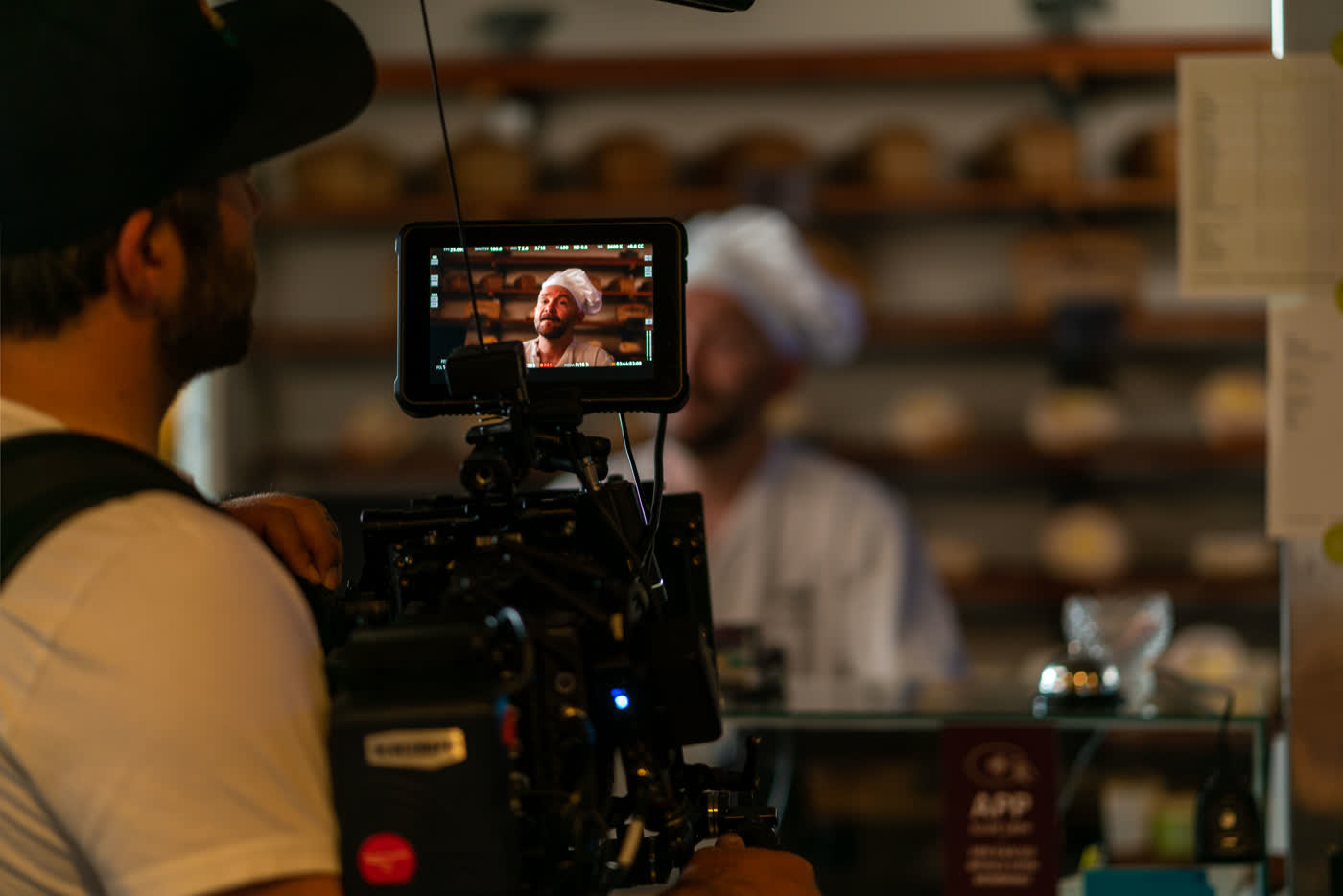
In 2026, AI is genuinely useful around a video production. It transcribes interviews, helps find the best lines, writes first-draft captions, cleans up audio, reframes footage for different platforms and can generate short, realistic clips with sound. What it can't do is film your actual people, your actual premises and your actual work, and for a brand film that's the whole point. Used for the jobs around the film, it saves time. Used to replace the film, it tends to cost you trust.
I'm not anti AI. I'd be lying if I said the tools weren't impressive, and some of them have made the dull parts of post-production faster. I just think businesses are being sold the wrong half of it.
What can AI video tools actually do now?
Generated video has moved quickly. Google's Veo 3.1 makes eight second clips, with sound generated alongside the picture, at up to 4K. OpenAI, Runway and others have their own models. Give them a decent prompt and you'll get a shot that looks expensive at first glance.
The less glamorous tools are where most of the day-to-day value sits:
- Transcription. Hours of interview turned into searchable text, so you can find every time someone mentioned a particular customer in seconds.
- Captions and subtitles. A first draft generated automatically, then checked by a person, because names and technical words still come out wrong.
- Audio clean-up. Background hum and room noise reduced on interviews recorded in real places.
- Reframing. A widescreen shot tracked and cropped to vertical for the feed.
- Small fixes. Extending a shot by a beat, upscaling an old clip, removing something distracting from the corner of a frame.
- Translation and dubbing. Including dubbing in a cloned version of the speaker's own voice.
Before the shoot, it's a decent thinking partner. Drafting interview questions, pressure-testing a structure, turning a messy brief into a shot list. None of that replaces the research, but it gets you to a first version faster.
What can't AI do for a brand film?
It can't film the thing that happened. A brand film works because it's evidence. That founder really did start in a shed. That customer really did trust you with their house. Those hands really did paint that sign. Generated footage can look like any of those, but it can't be any of them, and the moment a viewer suspects it isn't real, the evidence is gone.
 Signwriting Jack
Our Signwriting Jack film is a good test. The whole value is the hand: the brush loading, and a single unbroken line that either works or doesn't. You could generate a lovely shot of a brush making a perfect line. Nobody would care, because the reason to watch is that a person is doing it, live, with no undo button.
There are practical limits too. Eight second clips have to be stitched together, and keeping a face, a product or a room consistent across many shots is still fiddly. These models don't know your premises, your team or your products. And anything that leans on a real person's face or voice needs their consent, which gets complicated fast.
Do you have to tell people when a video uses AI?
Sometimes, and audiences increasingly expect you to. YouTube's disclosure rules ask creators to label content that makes a real person appear to say or do something they didn't, alters footage of a real event or place, generates a realistic scene that never happened, or uses generated music as the main focus. They don't ask you to disclose using AI for a script, an outline, captions, colour adjustment, upscaling or cloning your own voice for a dub.
In advertising, the UK's existing rules on misleading ads apply whatever tool made the picture. If generated imagery makes a product look better than it is, that's the same problem it always was.
If you use AI where people expect something real, most of your audience will want to know, and many will value the work less once they do.
Source: The Harris Poll UK, The Authenticity Trade-Off: How AI is reshaping trust in advertising, 2026
Where does AI genuinely help a production?
In the edit, mostly. An interview-led film gets found in hours of conversation, and anything that makes those hours searchable gives the editor more time to think about the story instead of scrubbing through footage. That's a real gain, and it goes into the film rather than into a shortcut.
It also helps with the cut-downs. Our films come back as a main film, a short cut and six to ten vertical pieces, and reframing and captioning all of those is exactly the kind of repetitive work these tools are good at. A person still checks every frame, but they're checking rather than building from scratch. If you just need to resize a clip yourself, our free video resizer does that in the browser.
Then there are the bits of a film nobody needs to believe are real. A conceptual opening, an abstract background behind a title, a visual metaphor. The Harris Poll UK research quoted above found people are noticeably more comfortable with AI in backgrounds and conceptual elements than in anything meant to look real.
Use AI for the jobs around the film. The moment it replaces the film, it starts costing you trust.
Should a brand use AI generated people or presenters?
For anything where trust is the point, I wouldn't. A generated presenter tells your customer that nobody in the business was willing to stand behind the message. The research backs that instinct up: people trust ads less as AI does more of the work, and they're especially wary in categories where realism is expected, like food, beauty and travel.
There's a reasonable case for it in training material, or quick internal updates that would never have been filmed properly anyway. Just be clear with yourself about the trade.
Will AI make brand films cheaper?
A bit, in places. The edit gets faster in the boring stages, and captions and versioning take less time. But the biggest single cost in a production is still the shoot day, because crew, kit and travel all scale with it, and no tool turns up at your workshop for you. Where it might save you money is in versioning: more cut-downs, subtitled versions in other languages, quicker turnaround on small changes. That's useful. It just isn't where most of the budget goes. We break the rest down in how much a brand film costs. If you want to talk about where AI fits into a film you're planning, honestly or not at all, get in touch.